Saturday, July 2, 2022

Back to Flings- Let's Start with Trees

Our recent Garden Blogger Fling was held in Madison Wisconsin. We had a beautiful weekend to explore both public and private gardens, all set up by our Madison bloggers, Beth Stetenfeld and Anneliese Valdes. Our bus rides took us both through Madison and across the local countryside. Views out the windows were great- those quintessential farms dotted the landscape.


We were able to see some remarkable trees both in the private gardens as well as in the University of Wisconsin-Madison Arboretum and Olbrich Botanical Garden.  One of the stops on our first day was a private garden with lovely gardens. There was a majestic Weeping Willow.  Salix babylonica
This large tree shades the garden and creates a great spot for all those shade loving hostas. The gardeners wandering about the garden give you a sense of size. 


 Many of the gardens were well treed, with pines, oaks, and serviceberries, to name just a few. In future posts more of the private gardens will be shared. 
The Olbrich Botanical Garden had a couple trees that I had to stop and photograph. One was the largest Cottonwood, Populus deltoides, I think I have ever seen. I asked fellow blogger, Lisa Wagner, to stand next to it for size reference. 

Look at that bark!

It looks big, but without a person in the photo, you can't be sure how big.

Cottonwood with Lisa for scale

Also in the Botanical garden is a large Sycamore. I saw a larger one in the James Madison Arboretum in Harrisonburg, VA but this one was pretty amazing. 

Here is the Sycamore in Madison, I love the white mottled bark, always so striking.
-

Onward to the UW-Madison Arboretum, there were a number of great trees. Near the entrance to the main building is a State Champion Black Gum, Nyssa sylvatica. Our guide, David Stevens was talking about the stunning fall color of this specimen.  During the summer growing season it is hard to get a good photo of this champ. If you can visit the UW-Madison Arboretum in the fall, be sure to look to the left of the building for an incredible show!
Black Gum

There were a number of Bottlebrush Buckeyes, Aesculus parviflora, both in the Arboretum and the Botanical garden. It is a great medium tree/large shrub. When in bloom the pollinators have a feast. In the photo below you can see all the flower stalks, ready to bloom.

Aesculus parviflora

A tree that I was not familiar with is the Fernleaf Elm. It is a large specimen, great branching and lovely glossy green leaves.  Ulmus 'Crispa'. It pays to have a guided tour of the Arboretum. He had so many stories about the history of the studies of various Crabapples, introductions of new Birch, a good specimen of a Polish Larch and if there had been time, our guide could have talked about each and every tree on the grounds. Had we not had the guide, the Elm might have been missed. 


Check out these wavy leaves!

A view from the back of the Fernleaf Elm

The trees that were spotlighted by our guide were amazing. On the grounds of this Arboretum, there are four mature American Chestnut, Castanea dentata. We all know about the loss of the Chestnut due to Chestnut blight across its native range where it was approximately 25% of the forest. Before the blight the Chestnut was widely planted both for its shade as well as lumber uses and seed production. Wisconsin is not in its native range. In the 1800-early 1900's Chestnuts were planted in Wisconsin as well as Minnesota. According to a study paper I read the theory for its success in these areas were both the isolation of these trees from the ones in the Appalachian mountain range and the Westerly winds. The study was written in 1975, so some of the data is not up to date. There was a National Champion Chestnut tree in Trempealeau county in Wisconsin on the Lunde farm. In 1960 this giant of a tree measured 11 feet circumference at 4.5 feet high, was 67 feet tall, and had a canopy spread of 55 feet. In 1975 it was superceded by a tree in Oregon City, Oregon that was measured at 15 ft. 8 in. circumference, 90 ft. tall, and a spread of 64 ft. 
The Chestnut trees in the UW-Madison Arboretum were presented to the arboretum by H. D. Tiemann, Forest Products Laboratory Director, however the date is not known. According to our guide, they were donated in the 1950's and planted in the Arboretum in the 1960's. (Had I had a pen that worked in hand my information would be more exact. I tried to find the information the guide told us, to no avail.) There were four Chestnuts planted and in 1974 were measured. The largest one was 15 ft. tall, 8.5 inches in circumference, and had an 8 foot spread. 
The stand of the four American Chestnuts really stood out as they were all in bloom! It was gorgeous! 
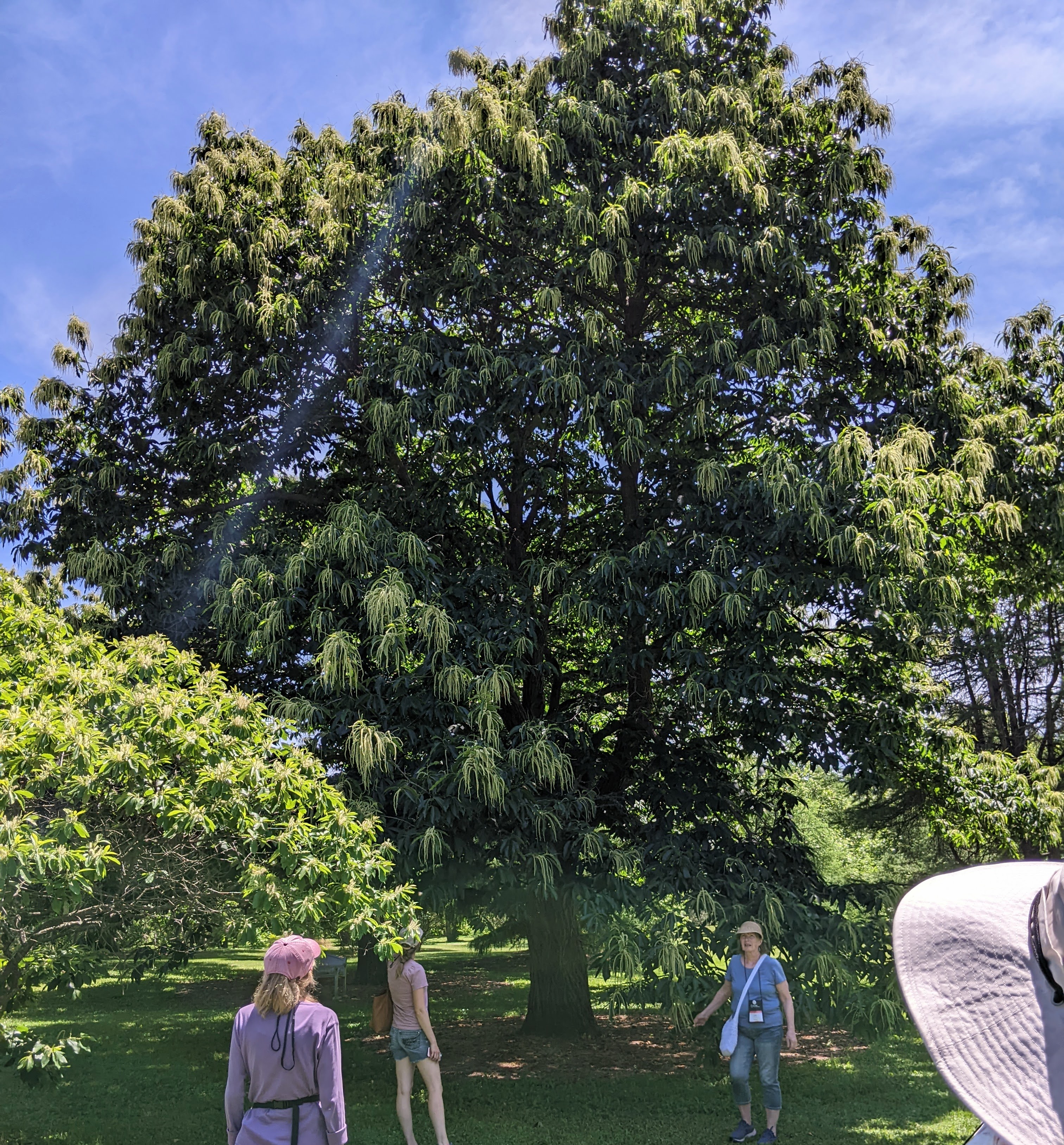

The Chestnut has both male and female flowers on one tree, monoecious. The long stalks are the male flowers. Their pollen is spread by wind and some pollinators.


Below is a photo of the Allegheny Chestnut, Castanea pumila, which was growing near the American Chestnuts. You can easily see the male and female flowers.


The American Chestnut seeds/nuts are edible- think Nat King Cole singing 'Chestnuts Roasting On An Open Fire'. Their hull is spiny. In the Arboretum many of the turkeys and deer enjoy eating these nuts. The leftover hulls are under the tree.


Wish we had more time in the Arboretum, there were so many great trees to see. Onward to more Fling posts...stay tuned.


©Copyright 2022 Janet. All rights reserved. Content created by Janet for The Queen of Seaford. words and photos by Janet,The Queen of Seaford.

Friday, May 6, 2022

Nature- Volunteers and Surprises

As it says in the heading of my blog, it is a random diary of what is going on in my garden. I need to get back to documenting growth of my garden. One of my neighbors said that they thought my garden had really popped this year. Will it be even better next year? Who knows, every year has so many variables  from late frosts to rainfall factoring in to benefit or challenge each year's growth.

The volunteers in my garden are always a treat to see. The various colors of Blue-eyed Grasses pop up in the spring. The blue flowered grass is Sisyrinchium angustifolium. 


The yellow flowered grass is most likely Sisyrinchium rosulatum. It isn't always yellow, sometimes they are pink to lavender. Always a nice little bloom to see in the garden/yard.


Don't you love the seed pods?

A new volunteer this year is Lyreleaf sage, Salvia lyrata. It is a vigorous spreader, maybe even a thug. I am not sure how it entered my garden. There really aren't Lyreleaf sage in our wild areas. Could it have come in on a plant from a plant sale? Maybe. 


 I like the purple and lavender colors together, Sage and Iris. There is a Gladiolus byzantine planted near the Irises, so in the coming years, we will get another color combination.


Why do I have a rose in the volunteer list? Well, this gorgeous deep red rose sprouted from root stock. I had a David Austin rose, Rosa 'Olivia' in a container in this garden bed. Sadly, it was just at deer eating height. When I dug the rose out of the container there were some roots that had traveled out of the hole in the bottom of the container and into the garden. I thought I had dug up all remaining roots, but it looks as though I was wrong. This unnamed red rose is probably a rambler based on its growth habit. This coming winter I will rework this corner of the garden. The rose is fragrant and a gorgeous deep red. I love it against the yellow of the creeping St. John's Wort, Hypericum calycinum 'Brigadoon'.


Surprises in the garden come in fauna form, some with legs and some without. Below is the ladybug/ ladybeetle feasting on aphids. Balance of nature!


We have lots of turtles in our neighborhood area. Being on the lake there are many sliders, this one headed off to the woods to perhaps lay her eggs. I made sure it was well off the road before venturing on.


We also have lots of box turtles in the garden. Love seeing all the turtles.


There are also snakes in the garden, or in this case, in my hose caddy on the patio. This is a Black Rat snake, nonvenomous and beneficial to the health of the garden. Like I said with the aphids and ladybugs, balance of nature. 


Hanging out in the front yard is one of many toads and frogs we have. I believe this one to be an American Toad, Bufo [Anaxyrus] americanus. 


And finally, Bambi was visiting in the backyard garden with her mom. It is a love/hate relationship with the numerous deer. The fawns are so stinkin' cute!


Stay tuned for more observations from my garden. Thanks for stopping by.


©Copyright 2022 Janet. All rights reserved. Content created by Janet for The Queen of Seaford. words and photos by Janet,The Queen of Seaford.

Tuesday, March 8, 2022

Blog- Fling- Blog- Fling- Blog


These past two years of COVID-19 have really gotten us out of the swing of things. This summer it is time to get back to what we love. We garden bloggers have been gathering together for years, going on what we call Garden Bloggers Fling. It started as a Spring Fling, but the calendar allowed for spring into summer trips, depending on the location of that year's Fling. You can read about my Fling experiences by clicking on the labels at the bottom of the post. 
This year's Fling will be in Madison Wisconsin. We will gather as gardener bloggers and leave as friends. The Fling will be June 23- 26, 2022. Our hosts Beth and Anneliese have a great line-up of gardens to visit. They have worked hard, first for the 2020 Fling, cancelled because of COVID, then moved to 2021-again COVID had other plans, and now 2022!! Registration is now open. The Garden Bloggers Fling link is here. 
If you are a garden blogger or Instagrammer, you are one of us! Come and join the ranks of Flingers. The details are here, on our Garden Blogger Fling page. While there you can explore some of the previous Flings, see what fun we have and all the great folks you will call friends. 
The sponsors are great supporters of our Fling. They help with costs of putting on the Fling and also share some of their products. You never know, you might come home with a new tool, a great plant, or a wonderful garden themed gift. (the rose pictured below was a donation from David Austin roses that I won!) 

Questions about the Fling? Ask me in the comments. You can also go to my Queen of Seaford Facebook page and ask there. On the fence about going? We have fun, the gardens are ALWAYS amazing, and the friendships are wonderful. Are you a garden blogger or have an Instagram page that focuses on gardening? We would love to meet you! Come and join the fun. 


©Copyright 2022 Janet. All rights reserved. Content created by Janet for The Queen of Seaford. words and photos by Janet,The Queen of Seaford.