Showing posts with label crape myrtle. Show all posts

Monday, July 4, 2022

I've Got a Dozen Under My Belt, On To Thirteen

Time sure flies! In 2010 we moved to South Carolina from Virginia. If I were to have to guess, I would say it was only 5 or 6 years! Wow. I hadn't done a yearly review of the yard/gardens for a couple years. Here are a few links to previous posts with photos of progress. I will just share this year's photos today.

Over the years we added a dry creek bed through the backyard, I highly recommend one if you have run-off in your yard that you want to direct. I added a short dry creek bed in the front yard to help with the mulch getting washed downhill. Our lake front area is a mess. I had it redone a few years ago with Hayscented ferns Dennstaedtia punctiloba, Panicum virgatum 'Shenandoah', and four Podocarpus macrophyllus 'Pringles Dwarf'. The ferns needed more water in some areas, the grasses didn't thrive like they should and the Pringles were eaten by the deer. The irrigation wasn't working like it should have. I had it set to go off in the wee hours of dawn, only to find an error code for valve one- the largest section of the yard. Now I manually start the sprinklers and they work fine. Not sure what the issue was. Finally, there was also a tree that fell onto the bank- crushing some of the grasses and ferns. I won't share that area today... maybe another time.

Front garden

The front garden is filled with four Drift Roses 'Popcorn', one Loropetalum 'Purple Pixie', Cercis canadensis 'Ruby Falls' Redbud. Multiple Calla lilies, Zantedeschia albomaculata, have reseeded, a volunteer fern, Thelypteris normalis, popped up by the downspout pop-up and there's plenty of Sedum rupestre 'Angelina' and Dianthus 'Firewitch' spreading along the sidewalk. 
The shed is almost hidden because of all the shrub growth. At the corner of the shed is a large Tea Olive, Osmanthus fragrans


The front yard from the other direction. In the small garden, in the photo above is Prunus mume 'Hokkia-bungo' which just shines in December and January. On a warm day the honey bees are all over the blooms, happy to have something blooming at that time of year. Groundcover along the driveway in that garden is Hypericum caylcinum 'Brigadoon'. In the photo below, you can get a better view of the newest garden. A few years ago I decided to mulch the center of the front yard and put in a pollinator garden. The armadillo population and I have a running battle with the plants in that garden. I say they should stay, the armadillo thinks there might be good eats under those plants. To protect the center of the garden I have a small garden fence/edging. In this mulched area I have four Japanese maples- Red Dragon, Butterfly, Virdis, and Crimson Queen. Inside the almost invisible barrier is a selection of Rudbeckia, Echinacea, Iris, Asclepias, Stokesia aster, Cranesbill Geranium, Vernonia, Penstemon, and Agastache. Anchoring the center of the large garden is Magnolia grandiflora 'Little Gem'. After being hit by a falling pine in a ice storm it has rebounded nicely. 
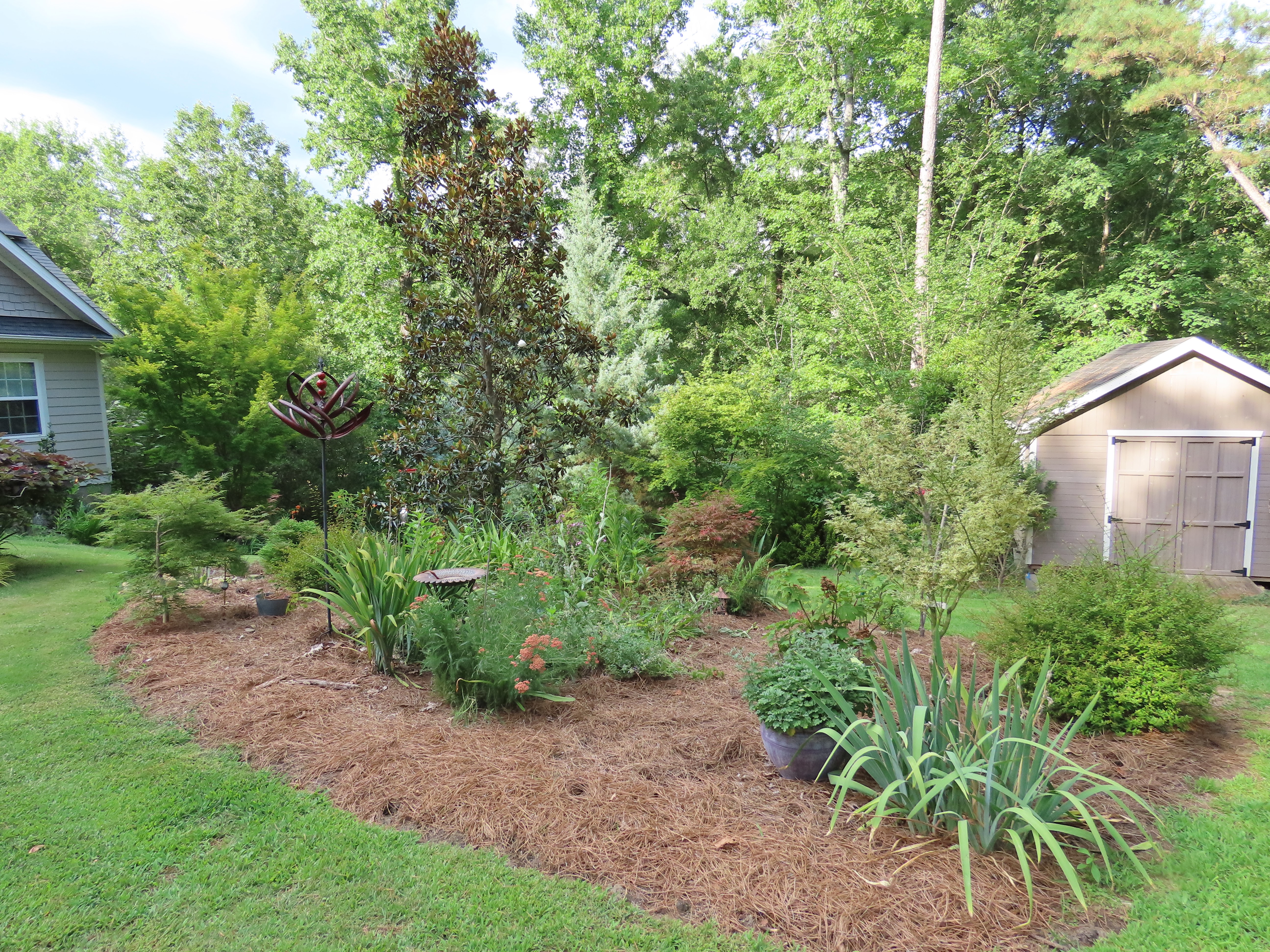

When I put in this large mulched bed, I had a washout of mulch. I finally ended up digging a trench and making my little dry creek bed. Hardwood mulch washes downhill too easily, so I changed it to be a pine straw mulch. Part way down the hill, in the bed, is a Crypotmeria globosa 'Nana', a really nice evergreen. Dotted along the edge of the rocks of the creek bed I planted a few Pitcher plants, Sarracenia flava. The one at the top of the hill I put a berm behind it to keep water at the plant's roots for a bit longer than if there was no berm. I have had success with them in the garden so I am going to get some of the other species. 


From the front yard we will walk around the house on the low side to the back. It is almost like tunnel to get to the back. The wax myrtles, Morella cerifera,  are now small trees. They needed to be limbed up or given a rejuvenating cut (to the ground). I like the small fruit available for the birds, so they got limbed up. On left as we walk through the tunnel is a nice sized blue hydrangea, Hydrangea macrophylla, the deer seem to leave this one alone. shhhh, don't tell them it is here. In the lower left corner is a Swamp Sunflower, Helianthus angustifolius still small, thanks to the deer. Behind the sunflower is my very tall Calycanthus sp. I would call it a small tree, not a shrub!


The backyard--
from below- Looking back up to the house. This is the garden area that lacked water last year, so I have some replanting to do both this fall and next spring. These mature trees soak up all the available water. 
You can see the dry creek bed cut across the lawn area. It curves around the gardens and works well. 


Turning around to the lake you see my biggest stand of mountain mint, Pycnanthemum muticum. The pollinators love it. All day long it is covered with various bees and wasps as well as butterflies. It is a mint, so it needs to be kept in bounds. In this garden it competes with ostrich fern, Matteuccia struthiopteris, who will win?


The backyard from the deck- views from above. In the photo below, the lower left corner of the photo is the Japanese maple 'Garnet', going strong. To the left of the maple is Amsonia x 'Seaford Skies'. I have sporadically cut it back over the years, after it blooms, to keep it from reseeding. Note to self- cut it back soon! 


The garden has so many mature trees, mostly oaks and hickory. I was challenged by some fellow gardeners at the Fling to count my trees. Maybe that will be a winter project. 


 Going along the side of the house on the higher side of the property is where I play with the dog. She loves to fetch. In the winter the water runs down through the yard, making it tough for the grass to grow. Maybe by fall the grass will have filled in. The shrubs along the house include a nice stand of Deutzia gracilis 'Nikko', three Camellias and a couple hydrangeas. The deer know these hydrangeas quite well. We had a late freeze this year and knocked back all the Deutzia blooms.  The garden that borders the woods has four or more St. John's Wort, Hypericum frondosum 'Sunburst', it reseeds a bit and I have replanted those tiny seedlings further along the garden.  


From the driveway looking down the side yard, the Edgeworthia chrysantha is quite large.


Last but not least is the garden up by the road. Two springs ago I installed irrigation to this garden. It has been growing in size, any gardener worth their salt will expand gardens to the space available! The Gaillardia is sprinkled throughout this garden. Front right corner is a Black Diamond Crepe Myrtle. Lagerstroemia indica 'Black Diamond Best Red'. Waving in the breeze is Stipa tenuissima 'Ponytails' grass. 


Thanks for joining me on a walk around the yard after twelve years in one place. Additions and subtractions will be coming in the following year(s). 

©Copyright 2022 Janet. All rights reserved. Content created by Janet for The Queen of Seaford. words and photos by Janet,The Queen of Seaford.

Thursday, July 12, 2018

Eight Years -Showing Warts and All

It has been a couple years since I did a yearly review of the gardens. Some garden areas have been successful and others have gotten quite overgrown.  Last year was not the year for tending to the garden and it is obvious to my eye. Below are comparison photos from 2017 and 2018. If you would like to see earlier years you can see 2010, 2011, 2012, 2013, 2014, 2015, and 2016.
In the photo below it is great to see how much the Japanese maple, Acer palmatum 'Glowing Embers' has grown. It is in the left side of the garden. 

2017
This past spring I added a garden along the wall, post on it later. The wall and the new garden seem to point to the 'Glowing Embers'.
It is funny how much the white Caladiums stand out along the pathway in the woods. I need to put more in next year.

2018
A little more of the center of the garden. The burgundy tree in the center is a Japanese maple- Acer palmatum dissectum 'Garnet'. The shape is finally coming back, a November 1 snowfall a few years ago took a third of the crown.
2018
Along side the house is always in a state of 'maybe it will be better next year'. The deer had found the hydrangeas last year and ate them to a nub. Around the propane tank is a very healthy stand of  Sweet Flag grass, Acorus gramineus 'Ogon'...home to many of my snakes and a favorite place for our little Liebling to "hide". In between the hose spigot and the propane tank is the A/C condensation pipe outlet. During the summer it is a constantly moist area. I like to use the downhill side of it to have my plant nursery. Any time I am pruning I will stick a few branches in the soil in that nursery area. I have had some success with a few Hydrangeas and Camellias and boxwood.

2017
This year you can see more growth on the Hydrangea macrophylla 'Madam Emile Mouillere', a white blooming mophead. Downhill from this hydrangea is a variegated one- it was also in the photo above, barely. Apparently variegated hydrangea are especially tasty to those pesky deer. Last year the hosta in front of the variegated hydrangea looked like celery stalks sticking up through the Sweet flag grass. Uphill from the Sweet Flag grass is a substantial stand of Deutzia gracilis 'Nikko', a deer resistant low growing shrub. In the spring it is very attractive if a late frost doesn't kill the blooms. The rest of the year it is a space filler.
You can see we have had to patch the turf again this spring. Slowly but surely it is filling in. We have eliminated more of the turf in the front yard.

2018
From the front door you see more Sweet Flag grass on the right side of the walkway. To the left there is a Cercis canadensis 'Ruby Falls', one side is always "pruned" by the deer and the other creeps across the walkway. A Loropetalum chinense var. rubrum 'Daruma' is in front of the front window. In some of the next photos you can see how much it has grown.
2017
This year's view shows some of the mulched front. With the dogs running out front, the trees creating more and more shade, and winter moisture killing the grass, we finally figured out that we needed to take a different tack.  So far I have added two more Japanese maples, 'Red Dragon' and 'Butterfly', a Camellia sasanqua 'Leslie Ann', and a small Cryptomeria. There is a lot more room to plant. Oh. the possibilities!

2018
Magnolia grandiflora 'Little Gem' has grown!  A few winters ago we had a pine tree hit it during an ice storm, spurring it to fill out and grow taller!
2018
Another view of the front yard, here in 2017, I have help from Liebling, our German Shepherd puppy. She will be 2 this August. See the large Loropetalum by the front by window? It was only supposed to get four to six feet tall. Each year it is cut back to the bottom of the window.

2017

Similar view this year, you can see the edge of the mulched area. See how much the Loropetalum is now? Yikes.  At the corner of the house is a Coral Bark Maple, Acer palmatum 'Sango Kaku'. It really has been a show stopper in the fall and winter with its leaf color and the coral bark.

2018

This spot is the uphill part of the front yard next to the driveway, planted with a few roses, lavender, irises, and a flowering apricot, Prunus mume 'Hokkai Bungo'. I enjoy the fragrance of the cinnamon scented blooms in the winter.
2017

This year you can see some of the lavender is missing. A peony or two have been added and a Calla lily, Zanteschia aethiopia. Some of the iris were uprooted by the marauding Armadillo. We have deer, rabbits, Armadillo, chipmunks, and voles to battle.
2018
A bright spot in the woods as you continue to walk up the driveway is an anise shrub, Illicium parviflorum 'Florida Sunshine'. I liked how it glowed in the woods so much that I bought three more, working my way up the driveway, three on the left and one on the right.

2018
A semi-new garden up at the street is shaping up. I do not have irrigation there, so the plants need to be drought tolerant and resistant to the deer that graze through. A few of the plants include Yucca filamentosa 'Color Guard', Hesperaloe parviflora, Lagerstroemia -a Red variety of the Black Diamond Crape Myrtle series, Amsonia x 'Seaford Skies', and lots of Nassella tenuissima - Ponytail Grass.
2018
Walking to the backyard from the bottom of the front hill. Viburnum tinus 'Spring Bouquet' on the left and Morella cerifera, Wax Myrtle, on the right. Not pleased with the Viburnum, going to cut them back a good bit and see if they shape up any better.
2018
In the lower part of the yard, last year's photo shows the dry creek bed we put in the year before. What a good asset to the landscape! It channels the rain water through the gardens and empties into the grassy flat land before going into the lake. The flat land has River Oats and other grasses that filter the water and slows it down....works like a charm!
2017
A little bit of a different angle in this year's photo. The elephant ears aren't making the showing they have in past years. I know I should have dug them up and divided them a few years ago. Oops.

2018
Here are the warts- last year's photo from the boat dock....lots of weeds on the right side. Almost no visible planted material to be seen.

2017
This year, even worse. Will be tackling it in the near future.  I just hate to get into that mess in the heat....and remember, there are snakes.
2018
Finally another view of the large mulched area in the front yard. My pitcher plant needs to be transplanted into a larger container, thinking it might become part of the garden. See my chicken? He is a water feature- trying to find the best place for it.

2018
Thanks for joining me on the yearly update, hard to believe we have been in South Carolina for eight years! I am glad I have been taking photos at the same time of year, year after year, to see the changes.


©Copyright 2018 Janet. All rights reserved. Content created by Janet for The Queen of Seaford. words and photos by Janet,The Queen of Seaford.

Wednesday, October 25, 2017

Hi Again, It's Me


As the temperatures get closer to overnight frosts in the Upstate of South Carolina, I thought I would share some of my fall blooms. Many are volunteers in the woods along the driveway. Others, as this Cyclamen are planted little jewels that pop up at a time where your eye looks for some color in the garden.

Cyclamen hederifolium

I let this little cutie reseed in various parts of the garden. If it isn't in a good spot, I have no qualms about 'weeding' it out. Who doesn't like a nice little yellow bloom?

Hypericum hypericoides

Another fall color in my garden is a bit of a mystery. I bought a flowering crab-apple a number of years ago, variety 'Golden Hornet'. Spring blooms- white with pink sepals- check. Green leaves- check. Yellow fruit- um, no. As this season has progressed the fruit is turning deeper and deeper red. I guess in the big scheme of life it doesn't really matter, I am glad it is producing fruit, just a little confusing.

Malus 'Golden Hornet'

Another volunteer in the woods is a tiny purple/lavender bloom. I have a thick stand of it near my well 'rock'. It is known as panicled-leaf tick-trefoil, its seeds stick to animals and people, they are the little triangular seeds- you've seen them. You probably had to pick them off your socks and pant legs.

Desmodium paniculatum var. paniculatum

Another planted beauty comes from my friend Julie Adolf, of Garden Delights. A white toad lily with a kiss of lavender on the tips of its petals and a yellow spot in the throat. Fall bloomers are so nice to have in the garden, sadly the bunnies also love them.

Tricyrtis latifolia

Putting on a good show this year is my black leafed Crape Myrtle. It took a few years for it to really shine. The beautiful dark leaves and this pure red bloom are a nice combination.


Black Diamond Crimson Red

A few fun native blooms popping up in the fall include this Sida, said to be edible (though I would not recommend anyone eating anything unless you know for sure what it is and it is safe). Some of my reading says this is a shrub, though in my yard it is a small woody forb.  A common name is Wire-weed. Doesn't sound appetizing does it?


More yellows in the fall include various Goldenrods and Goldenasters. The pollinators love these!


And finally, a repeat bloomer from early spring, the lovely "Lemon Pledge" fragranced bloom of the Magnolia. I love every stage of this bloom, from tight bud, ready to pop- to the seed pod of a spent bloom with its bright red seeds emerging from the pod. If you are in a zone that can handle Magnolias- plant one- you won't be sorry.

Magnolia grandiflora 'Little Gem'


©Copyright 2017 Janet. All rights reserved. Content created by Janet for The Queen of Seaford. words and photos by Janet,The Queen of Seaford.

Tuesday, August 11, 2009

Tuesday's Trees- Crape Myrtle


This week's tree is a very versatile plant...both tree and shrub depending on variety. Once again our friend Les at A Tidewater Gardener did a wonderful post on some of the Crape Myrtle around town. It is truly a plant used in the landscape in the south.

There are multiple colors and sizes from which to choose. Every year there are more cultivars coming onto the market. When I first planted Crape Myrtles in my Texas landscape there were few small varieties available, now there are quite a few. Crape Myrtles, Lagerstroemia indica, are available in miniature shrub form to medium tree. The mistake many people make is trying to put a medium tree in a space where they want a small tree.

Too much pruning or incorrect pruning is hard on a tree. Many landscape companies pollard Crape Myrtles and this is an invitation to shorten the life of this plant. I was schooled in the Master Gardener course work under Jim Orband, York County Cooperative Extension. Proper pruning techniques are taught to and by the Master Gardener group. A great publication was put together in direct application for pruning and caring for Crape Myrtles.


In our Learning Garden we have two of the small shrub varieties of Crape Myrtle. Both are nicely shaped shrubs that require little if any pruning.

Both are about 4 or 5 years old. Chickasaw has a smaller leaf than the Pocomoke.

Besides pruning errors, incorrect placement in the garden impedes blooming.

This poor little tree has seldom bloomed. You can see how shaded it is from the oaks in the same yard.

Crape Myrtle are prone to powdery mildew, though newer varieties are being advertised as mildew resistant. I have one of these varieties. Dynamite is a super red and very disease resistant.


This beauty is in my ballet teacher's garden. Mature Crape Myrtles are wonderful, they give beauty in the summer with their blooms, fall with their foliage color and in the winter you see exfoliating bark many varieties have.


As I said earlier, Crape Myrtles are used in the landscape -- sometimes with multiple plantings of the same color....

And sometimes with many colors...


In addition to the York County publication mentioned above, there are some wonderful websites to explore all the different colors and sizes of this plant.

One is http://plantanswers.tamu.edu/trees/crapemyrtle/index.html click on the link Variety Characteristics by Name and the link Variety Characteristics by Size. These are two links that have pictures of groupings of various colors and size.

http://www.fast-growing-trees.com/CrapeMyrtles.htm is another site that gives information on individual trees.

Many of the Crape Myrtles have Indian names. These are cultivars developed in the United States and are some of the more mildew resistant. Some of the new varieties are more cold hardy and more compact in growth pattern.

I hope you check out some of the Crape Myrtles...perhaps there is one for your garden!!


Fall color varies with the Crape Myrtle. Here are a couple great examples of great fall color.


Next week is Shagbark Hickory....come back!