Showing posts with label trees. Show all posts

Sunday, March 23, 2025

Photo-a-Day Week 12

If you are still reading along, we are now reviewing week 12. Travel has made it interesting as I am not following my regular routine. 

Day 76- 
Power substations dot our area. This one is on the way to where we board our dogs. 

Power


Day 77-
As we drove up to New Jersey to babysit for a week, we were presented with this glorious sunrise just outside of Charlotte, NC. 

Sunrise

Day 78- 
We babysat our 4-year-old granddaughter this week. There were a lot of puzzles done, some more than once. She is a whiz at puzzles!

Puzzles


Day 79-
I know many who saw this photo thought this was a real lizard! Nope, we bought one for each of our grandkids (at the time) and this one is enjoyed in the bath. At first I thought we bought it at one of the many zoos we have frequented since having grandkids but after some thought my husband said we purchased it at Missouri Botanical Garden gift shop. He was right!

Bath time


Day 80-
One day we went to Greenway Meadows to let her play on the playground and run! This was once part of the lower farm of Archibald Douglas Russell's 247-acre estate at the turn of the 20th century. This property was purchased in 1949 by Robert Wood Johnson, of the Johnson and Johnson family, The lands are in the D & R Land Trust, in 2001 55 acres were deeded to Princeton, creating Greenway Meadows Park. You can read about it here. 

London Plane tree


Day 81-
If you drive around New Jersey you understand why it is called the Garden State. Many farms dot the landscape, this one is just outside Princeton. 

Farm


Day 82-
This day we went to the Elmwood Zoo. I took a photo of the fountain, which is just outside the entrance and gift shop area. 

Water


©Copyright 2025 Janet. All rights reserved. Content created by Janet for The Queen of Seaford. words and photos by Janet, The Queen of Seaford.

Sunday, February 9, 2025

Photo-a-Day Week 6


Day 34-
This week's photos started with a picture of Fiona with her toy, coming down the driveway. I used the app on my cellphone called Prisma to change it up. 

Prisma Filter

Day 35-
Remember the crystal in the cabinet I shared on Day 23? Well, the setting sun shines through the dining room window and creates rainbows across the room. 

Rainbow

Day 36-
A lone pinecone on the driveway, the sun shining behind it creating a perfect shadow.

Pinecone

Day 37-
On the drive into town, I noticed a group of dead pine trees. I was surprised they were still standing after the hurricane that came through at the end of September. I used a black-and-white filter to enhance the photo. 

Dead Trees

Day 38-
This one was a challenge as I was walking the dog when I saw this snail. If I paid too much attention to the snail a rather nosey puppy would have interrupted the photo. 

On The Move

Day 39-
Every morning I enter our closet off the master bathroom and check the progress of the Camellia blooms. When I planted this Camellia the deer sampled its buds on the front part of the shrub. Over the years the buds have increased front and back. It is a no-name shrub I purchased years ago. I do not like it when plant tags just say "Camellia" no further information. 

View from my Window

Day 40-
The Prunus mume 'Hokkai bungo' is starting to lose its flowers. I was worried the freezing temps we had when the blooms first started opening would kill all the flowers. The tree bloomed in abundance this year to my pleasure. 

Fallen Petals

This wraps up another week. See you next week!


©Copyright 2025 Janet. All rights reserved. Content created by Janet for The Queen of Seaford. Words and photos by Janet, The Queen of Seaford.

Saturday, July 2, 2022

Back to Flings- Let's Start with Trees

Our recent Garden Blogger Fling was held in Madison Wisconsin. We had a beautiful weekend to explore both public and private gardens, all set up by our Madison bloggers, Beth Stetenfeld and Anneliese Valdes. Our bus rides took us both through Madison and across the local countryside. Views out the windows were great- those quintessential farms dotted the landscape.


We were able to see some remarkable trees both in the private gardens as well as in the University of Wisconsin-Madison Arboretum and Olbrich Botanical Garden.  One of the stops on our first day was a private garden with lovely gardens. There was a majestic Weeping Willow.  Salix babylonica
This large tree shades the garden and creates a great spot for all those shade loving hostas. The gardeners wandering about the garden give you a sense of size. 


 Many of the gardens were well treed, with pines, oaks, and serviceberries, to name just a few. In future posts more of the private gardens will be shared. 
The Olbrich Botanical Garden had a couple trees that I had to stop and photograph. One was the largest Cottonwood, Populus deltoides, I think I have ever seen. I asked fellow blogger, Lisa Wagner, to stand next to it for size reference. 

Look at that bark!

It looks big, but without a person in the photo, you can't be sure how big.

Cottonwood with Lisa for scale

Also in the Botanical garden is a large Sycamore. I saw a larger one in the James Madison Arboretum in Harrisonburg, VA but this one was pretty amazing. 

Here is the Sycamore in Madison, I love the white mottled bark, always so striking.
-

Onward to the UW-Madison Arboretum, there were a number of great trees. Near the entrance to the main building is a State Champion Black Gum, Nyssa sylvatica. Our guide, David Stevens was talking about the stunning fall color of this specimen.  During the summer growing season it is hard to get a good photo of this champ. If you can visit the UW-Madison Arboretum in the fall, be sure to look to the left of the building for an incredible show!
Black Gum

There were a number of Bottlebrush Buckeyes, Aesculus parviflora, both in the Arboretum and the Botanical garden. It is a great medium tree/large shrub. When in bloom the pollinators have a feast. In the photo below you can see all the flower stalks, ready to bloom.

Aesculus parviflora

A tree that I was not familiar with is the Fernleaf Elm. It is a large specimen, great branching and lovely glossy green leaves.  Ulmus 'Crispa'. It pays to have a guided tour of the Arboretum. He had so many stories about the history of the studies of various Crabapples, introductions of new Birch, a good specimen of a Polish Larch and if there had been time, our guide could have talked about each and every tree on the grounds. Had we not had the guide, the Elm might have been missed. 


Check out these wavy leaves!

A view from the back of the Fernleaf Elm

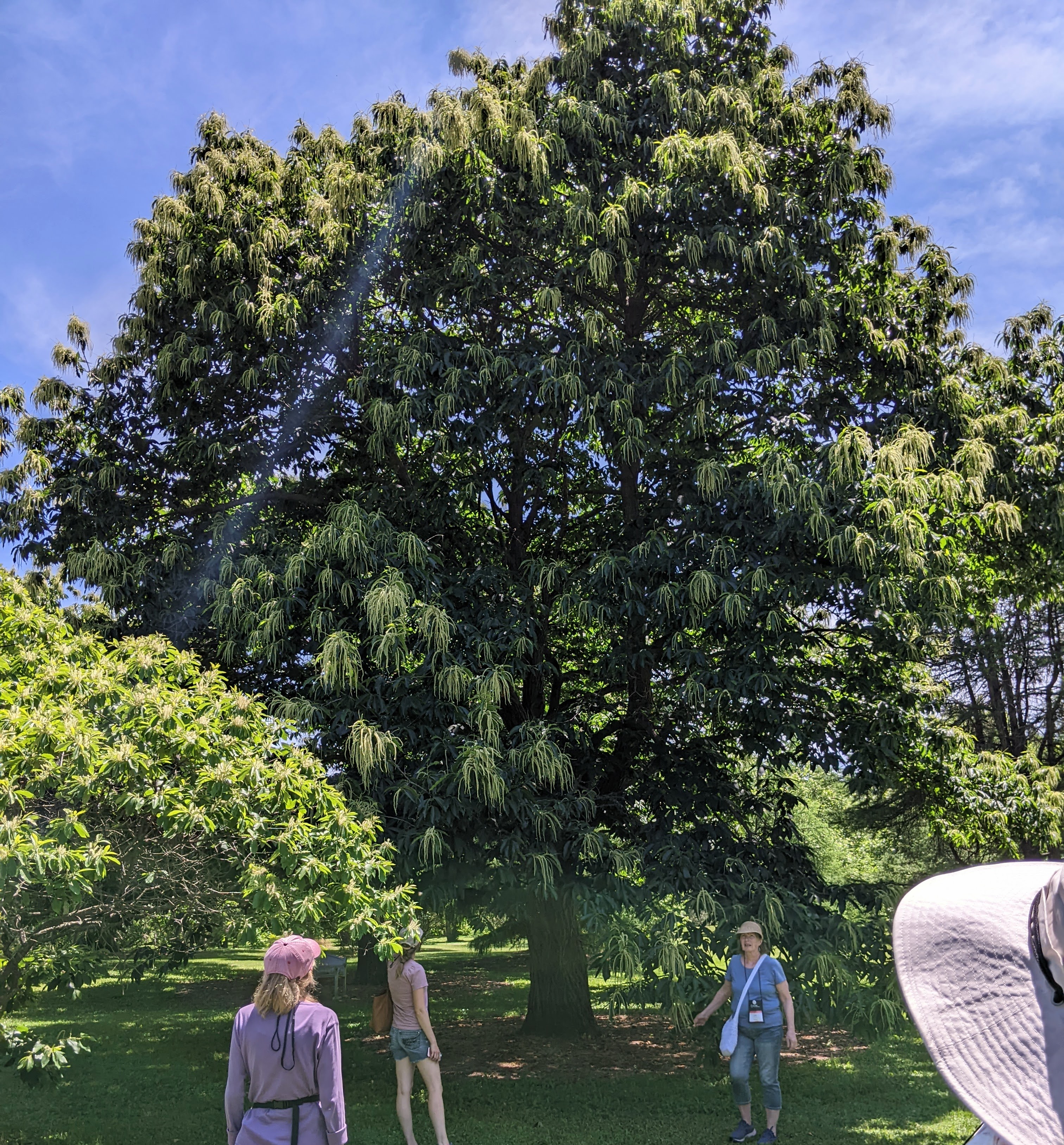
The trees that were spotlighted by our guide were amazing. On the grounds of this Arboretum, there are four mature American Chestnut, Castanea dentata. We all know about the loss of the Chestnut due to Chestnut blight across its native range where it was approximately 25% of the forest. Before the blight the Chestnut was widely planted both for its shade as well as lumber uses and seed production. Wisconsin is not in its native range. In the 1800-early 1900's Chestnuts were planted in Wisconsin as well as Minnesota. According to a study paper I read the theory for its success in these areas were both the isolation of these trees from the ones in the Appalachian mountain range and the Westerly winds. The study was written in 1975, so some of the data is not up to date. There was a National Champion Chestnut tree in Trempealeau county in Wisconsin on the Lunde farm. In 1960 this giant of a tree measured 11 feet circumference at 4.5 feet high, was 67 feet tall, and had a canopy spread of 55 feet. In 1975 it was superceded by a tree in Oregon City, Oregon that was measured at 15 ft. 8 in. circumference, 90 ft. tall, and a spread of 64 ft. 
The Chestnut trees in the UW-Madison Arboretum were presented to the arboretum by H. D. Tiemann, Forest Products Laboratory Director, however the date is not known. According to our guide, they were donated in the 1950's and planted in the Arboretum in the 1960's. (Had I had a pen that worked in hand my information would be more exact. I tried to find the information the guide told us, to no avail.) There were four Chestnuts planted and in 1974 were measured. The largest one was 15 ft. tall, 8.5 inches in circumference, and had an 8 foot spread. 
The stand of the four American Chestnuts really stood out as they were all in bloom! It was gorgeous! 


The Chestnut has both male and female flowers on one tree, monoecious. The long stalks are the male flowers. Their pollen is spread by wind and some pollinators.


Below is a photo of the Allegheny Chestnut, Castanea pumila, which was growing near the American Chestnuts. You can easily see the male and female flowers.


The American Chestnut seeds/nuts are edible- think Nat King Cole singing 'Chestnuts Roasting On An Open Fire'. Their hull is spiny. In the Arboretum many of the turkeys and deer enjoy eating these nuts. The leftover hulls are under the tree.


Wish we had more time in the Arboretum, there were so many great trees to see. Onward to more Fling posts...stay tuned.


©Copyright 2022 Janet. All rights reserved. Content created by Janet for The Queen of Seaford. words and photos by Janet,The Queen of Seaford.

Tuesday, February 21, 2017

Winter Walk-Off 2017, Spoiler Alert -- There are Snakes


Hard to believe it is that time again, time for the Winter Walk-Off, a blog meme sponsored by my friend Les at A Tidewater Gardener. The rules are the same as last year, and all previous years-- Powered under your own two feet, explore your area and photograph it. No photos of your own garden. Post your walk and link back to Les' blog. His post is here, so you can read the fine details. Participants have a chance to win one of two prizes. I can attest to the fact that the prizes are pretty nice. 

So on with our walk. Last year, well really a year ago Thanksgiving, we started walking. I mentioned my daily steps last year in my Walk-Off post.  Last year my daily goal was 11,000 steps a day. I increased my goal to 12,500 sometime this winter. A daily walk, regardless of the weather, is good for you. I am so glad we walk, though there are days where I am not as motivated as others. 

Our neighborhood street, heavy traffic

 As we walked today, I noticed how early all the trees are budding and some are blooming. This is the time of year where I like seeing the pears. The white blooms are pretty, but what a weedy, thorny, invasive, weak-wooded tree.


The Houstonia sp., Quaker Ladies or Little Bluets, are blooming now. We have a couple different varieties. H. caerulea and H. pusilla are the most common.


Such sweet little blooms


As I said, we walk, the 'we' being my husband and I with our dogs. This past October we got a new puppy, my husband is walking her in this photo. Liebling is a German Shepherd. She will be 6 months old on Thursday. To see more puppy pictures, check out my Flickr link on the sidebar.


Here she is with our older dog, Skyler. He is thirteen years old and still active. Today we walked to our neighborhood gazebo- a longer walk than what we have done since getting Liebling, about 4 miles round trip. 


More early bloomers are the vines native to our area, Carolina Jessamine, Gelsemium sempervirens. It usually blooms a month or so later.  


Another tree blooming is the Winged Elm, Ulmus alata. Rather a scruffy tree, but with the 'winged' appendages it is quite sculptural.  


I hadn't planned on taking photos for this post today until I encountered this little guy--
The warm weather has the frogs singing and the snakes emerging. This is the first snake of the season for us. All photos for this post were taken with my cell phone!

Brown Snake
Kind of scary looking right? Not really. He is tiny. Brown Snakes are not large snakes but good to have in the garden. With all the voles we have in our garden, I welcome each and every snake! To read more about the Brown Snake, this website has some great information- Savannah River Ecology Laboratory. After our photo shoot I moved him off the road so he won't have a mishap with a passing car.

See, not that big!
Hope you enjoyed our little stroll. Go over to A Tidewater Gardener to see where Les walked and the others who are joining the Winter Walk-Off 2017.


©Copyright 2017 Janet. All rights reserved. Content created by Janet for The Queen of Seaford. words and photos by Janet,The Queen of Seaford.

Sunday, November 1, 2015

Oh, How I've Longer for You


Baby Sourwood
Many of you know how much I love trees. One tree in particular that I have yearned for, for years, is a Sourwood, Oxydendron arboreum. During autumn these trees really shine. The foliage color ranges from green to various shades of red to peach to salmon. I was able to find some small ones semi-locally via the internet from Mail Order Natives. Theirs are small, about 8 to 12 inches tall, I bought four. Further internet searches lead me to a native plant nursery within an hour and a half drive. After a few messages back and forth with the folks at this nursery we made plans to visit.


Friday we took a drive up to Greer to Southern Heritage Nursery, a perfect day for an afternoon in the mountains. Mary, one of the owners was ready for us when we got there. As my camera was charging at home, I don't have photos of the nursery, but rest assured, we will go back. Photos will come in the future.


Fall through early winter a perfect time to plant in our area. The rainfall in the winter helps establish the root systems while the above ground portions of the plant are dormant. Since we have had some recent rains the soil in the woods/gardens are quite workable. Our soil is clay based, though in the woods there is a layer of leaf litter compost that helps add in nutrients. In addition to the three lovely Sourwood trees I came home with a native Smoke tree, Cotinus obovatus, and a Sassafras albidum. Don't you just love that salmon/peach color of the new trees?

New fall color waiting to be planted

 I already had one Sassafras in the garden, but that little tree is only 6 inches tall. It is a host plant for the Spicebush butterfly caterpillar. My tiny Sassafras has about four or five leaves, hardly enough for more than one cat to enjoy.
Small Sassafras
With rain in the forecast, getting my new plants in the ground was high on my agenda for today. While I had an idea where most of my new trees were going to be planted, minor adjustments were needed when the holes were dug. Rocks and roots make for hard digging. I am happy to say all trees now have new homes in my garden.
One Sassafras and Two Sourwoods (follow the arrows)
The southern exposure is towards the road, so these newly added trees will have full to dappled sunshine all year long.

Doesn't this color glow?
Smoketree
I had researched a Cotinus earlier this year, thinking I wanted one for a newly added garden area in the front yard. I was looking at some of the cultivars that were deeper purple, Cotinus coggygria 'Royal Purple'.  I ended up moving Prunus mume 'Hokkai Bungo', a flowering apricot purchased last February, to that spot. It wasn't happy where it was, so moving it seemed to be the right answer. We shall assess its placement this winter when (and if) it blooms. This variety blooms in January-February time frame and its blooms have a cinnamon fragrance. Back to the Smoke tree, buying the native variety seems to be a better answer. I am such a sucker for red/orange/peach fall colored plants. Stay tuned for updates on the trees as they grow and mature. 


©Copyright 2015 Janet. All rights reserved. Content created by Janet for The Queen of Seaford. words and photos by Janet,The Queen of Seaford.

Monday, January 28, 2013

A Little Bit of This and A Little Bit of That

This time of year there are some gardening days and some days to stay in and enjoy a warm fire.   Since we moved here in the summer of 2010 I have been buying plants from the Abbeville Extension Office. Here is  2012 The order is due in November and usually is delivered in mid-December.  This year the weather has been so warm that the plants didn't go dormant on the usual schedule.  The delivery date was pushed back to mid-January.    This year I ordered two crabapples, one Malus 'Red Silver' and one M. 'Golden Hornet'.  Both are semi-weeping.  The Red Silver has bronzy purple leaves and wine red flowers and purple red fruit while the Golden Hornet has white flowers with yellow fruit and green leaves.
Apparently I also ordered two Spirea x vanhouttei.  I forgot I had added those to the order form...think I did it on our way over to turn in the order form.   I couldn't remember where I had planned on planting the spirea.  Oh well, we gardeners love a challenge don't we?


The flowering crabapples were to be planted up by the street along the front of the woods.   In early November I was emptying out one of my worm bins and used some of the castings in the predetermined spots for my future crabs.   To remind myself where I had worked the soil and added the worm castings, I got a big stick and stuck it in the ground when the amending was done.   Yes, in the photo below is my stick.  The neighbors wondered if I was "planting" sticks....oh that crazy Janet.

The holes were pretty easy to dig in January after my earlier preparation.   The spirea found a spot along the driveway and in front of the woods.  Not bad for a quick planting day!!  My newly planted tree is just above the 'h' in my web link on the picture.   With hope and a little water (and no deer) I will be sharing some nice flower photos in the spring. 


And a little fun-- when finally taking down my Christmas wreath  I found there were about five anole hiding in the browning greenery.  They were just about as startled as I was!

Some were really tiny and their colors ranged from brown to green.


When I shooed away all the anoles, I was able to take down the wreath and remove the dead branches, save the decoration and put it away for another year.  


These little guys live in and around the stones on the front of our house.  You can tell it is a warm day if the anoles emerge.

These are the yellow paperwhites, Narcissus 'Grand Soleil d'Or'.  I planted 50 of them in the septic field across the street from the house.  The plan was to disperse them mid-way through the half acre.  Bad idea.  These are sweet little blooms, blooming in December/ January.  Since this is the septic field we bushhog the field in the late fall, after the first frost.  Well, the first frost is also when these little blooms are about 12 to 18 inches tall.  That is not a good time to cut the field.  Luckily they were not damaged from the cutting...but I didn't want to worry each year, so I dug them up and moved them last week.

I planted them along the edge of the driveway, so you could see and enjoy them.   See how tiny they are?


The Edgeworthia chrysantha is still going strong, and will for another month and a half at least.


Also growing in the backyard is a lot of moss.  Moss is really an interesting plant and very pretty.

Next time you see some moss growing, give it a closer look.

Also continuing to bloom is the Hamamelis vernalis, Ozark Witch hazel.  What a great plant!!

A new addition to my garden is a Candytuft, Iberis sempervirens 'Purity'.  I had other Candytufts, but just two and wanted to get a third.  The one I bought was blooming already!!  I wonder if it will continue to bloom all through the season? 


Now for your bird fix-- first a couple Goldfinches..one with more of its summer coloring than the other.


The first time I saw this next bird, I thought it was a mutant Robin.  It is about the same size, same colors, but very different.  Turned out to be an Eastern Towhee.  We rarely see them unless we are outside as they are ground feeders.  This one was scratching around in the leaves in the next lot until I walked along the side of the house.  This male Towhee flew up to a branch to keep an eye on me.
Don't forget the Great Backyard Bird Count on February 15- 18th weekend.    You keeping an eye on your birds?

©Copyright 2012 Janet. All rights reserved. Content created by Janet for The Queen of Seaford. words and photos by Janet,The Queen of Seaford.