Showing posts with label American Chestnut. Show all posts

Saturday, July 2, 2022

Back to Flings- Let's Start with Trees

Our recent Garden Blogger Fling was held in Madison Wisconsin. We had a beautiful weekend to explore both public and private gardens, all set up by our Madison bloggers, Beth Stetenfeld and Anneliese Valdes. Our bus rides took us both through Madison and across the local countryside. Views out the windows were great- those quintessential farms dotted the landscape.


We were able to see some remarkable trees both in the private gardens as well as in the University of Wisconsin-Madison Arboretum and Olbrich Botanical Garden.  One of the stops on our first day was a private garden with lovely gardens. There was a majestic Weeping Willow.  Salix babylonica
This large tree shades the garden and creates a great spot for all those shade loving hostas. The gardeners wandering about the garden give you a sense of size. 


 Many of the gardens were well treed, with pines, oaks, and serviceberries, to name just a few. In future posts more of the private gardens will be shared. 
The Olbrich Botanical Garden had a couple trees that I had to stop and photograph. One was the largest Cottonwood, Populus deltoides, I think I have ever seen. I asked fellow blogger, Lisa Wagner, to stand next to it for size reference. 

Look at that bark!

It looks big, but without a person in the photo, you can't be sure how big.

Cottonwood with Lisa for scale

Also in the Botanical garden is a large Sycamore. I saw a larger one in the James Madison Arboretum in Harrisonburg, VA but this one was pretty amazing. 

Here is the Sycamore in Madison, I love the white mottled bark, always so striking.
-

Onward to the UW-Madison Arboretum, there were a number of great trees. Near the entrance to the main building is a State Champion Black Gum, Nyssa sylvatica. Our guide, David Stevens was talking about the stunning fall color of this specimen.  During the summer growing season it is hard to get a good photo of this champ. If you can visit the UW-Madison Arboretum in the fall, be sure to look to the left of the building for an incredible show!
Black Gum

There were a number of Bottlebrush Buckeyes, Aesculus parviflora, both in the Arboretum and the Botanical garden. It is a great medium tree/large shrub. When in bloom the pollinators have a feast. In the photo below you can see all the flower stalks, ready to bloom.

Aesculus parviflora

A tree that I was not familiar with is the Fernleaf Elm. It is a large specimen, great branching and lovely glossy green leaves.  Ulmus 'Crispa'. It pays to have a guided tour of the Arboretum. He had so many stories about the history of the studies of various Crabapples, introductions of new Birch, a good specimen of a Polish Larch and if there had been time, our guide could have talked about each and every tree on the grounds. Had we not had the guide, the Elm might have been missed. 


Check out these wavy leaves!

A view from the back of the Fernleaf Elm

The trees that were spotlighted by our guide were amazing. On the grounds of this Arboretum, there are four mature American Chestnut, Castanea dentata. We all know about the loss of the Chestnut due to Chestnut blight across its native range where it was approximately 25% of the forest. Before the blight the Chestnut was widely planted both for its shade as well as lumber uses and seed production. Wisconsin is not in its native range. In the 1800-early 1900's Chestnuts were planted in Wisconsin as well as Minnesota. According to a study paper I read the theory for its success in these areas were both the isolation of these trees from the ones in the Appalachian mountain range and the Westerly winds. The study was written in 1975, so some of the data is not up to date. There was a National Champion Chestnut tree in Trempealeau county in Wisconsin on the Lunde farm. In 1960 this giant of a tree measured 11 feet circumference at 4.5 feet high, was 67 feet tall, and had a canopy spread of 55 feet. In 1975 it was superceded by a tree in Oregon City, Oregon that was measured at 15 ft. 8 in. circumference, 90 ft. tall, and a spread of 64 ft. 
The Chestnut trees in the UW-Madison Arboretum were presented to the arboretum by H. D. Tiemann, Forest Products Laboratory Director, however the date is not known. According to our guide, they were donated in the 1950's and planted in the Arboretum in the 1960's. (Had I had a pen that worked in hand my information would be more exact. I tried to find the information the guide told us, to no avail.) There were four Chestnuts planted and in 1974 were measured. The largest one was 15 ft. tall, 8.5 inches in circumference, and had an 8 foot spread. 
The stand of the four American Chestnuts really stood out as they were all in bloom! It was gorgeous! 
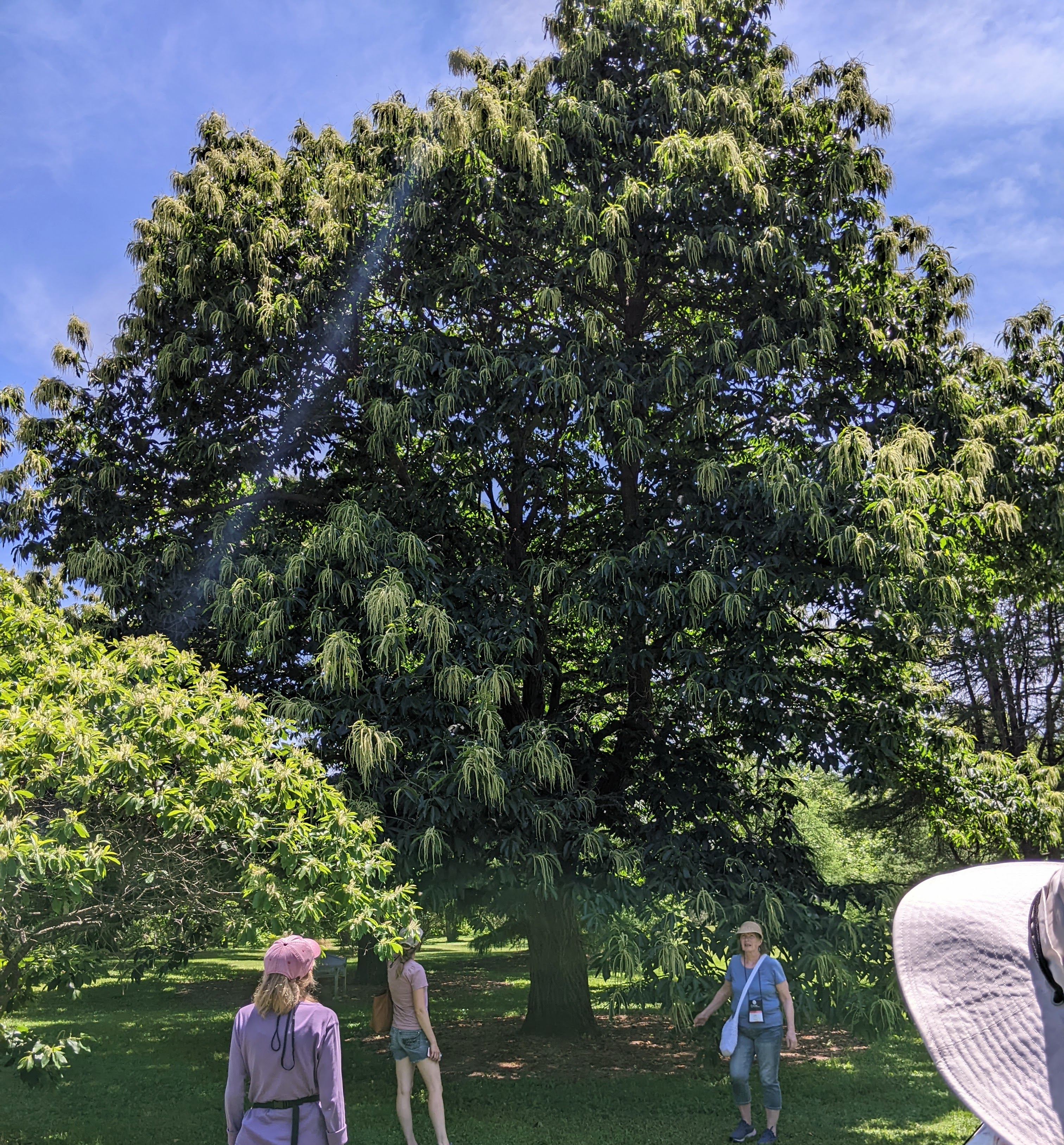

The Chestnut has both male and female flowers on one tree, monoecious. The long stalks are the male flowers. Their pollen is spread by wind and some pollinators.


Below is a photo of the Allegheny Chestnut, Castanea pumila, which was growing near the American Chestnuts. You can easily see the male and female flowers.


The American Chestnut seeds/nuts are edible- think Nat King Cole singing 'Chestnuts Roasting On An Open Fire'. Their hull is spiny. In the Arboretum many of the turkeys and deer enjoy eating these nuts. The leftover hulls are under the tree.


Wish we had more time in the Arboretum, there were so many great trees to see. Onward to more Fling posts...stay tuned.


©Copyright 2022 Janet. All rights reserved. Content created by Janet for The Queen of Seaford. words and photos by Janet,The Queen of Seaford.

Wednesday, November 14, 2012

Tuesday's Trees- American Chestnut

The mighty American Chestnut tree, the once grand giant tree is on the verge of disappearing.  Many of us know of the Chestnut Blight, Cryphonectria parasitica, and its affect on the tree.   At the turn of the last century the American Chestnut started dying in large numbers.  This fast growing, large tree, was developing  cankers.  These cankers run around the cambium layer of tree, killing first the leaves, then branches, and finally all above ground plant material is dead.  


The American Chestnut, Castanea dentata, once had a native range from Maine to Georgia and west to Ohio.  It was approximately 25% of the forest.  It is now either on endangered species list or special concern lists for many states.     
It is a fast growing, straight tree that can achieve heights over 100 feet in good conditions.  A mature tree can have a diameter of 17 feet.  These were huge trees.  Interestingly it was branch free on the lower part of the tree, sometimes up to 50 feet of trunk before branching.  


It was called the cradle to coffin tree.  From fine furniture to railroad ties, fuel to posts, this tree constituted more than 50% of the timber produced before the blight.  The timber is decay resistant, making it a useful wood for many applications.   Wildlife benefited from its nut production.   Bears to raccoon to deer to humans, everyone found the nut a good food source.  Trees will fruit 5- 7 years of age.  It needs another Chestnut to cross pollinate even though it is monoecious.  Much of the economy was based on the American Chestnut.  The bark and the wood were a great source of tannic acid, used for tanning leather.  After the blight killed a tree, the timber that remained was still used.  Worms had bored into the wood, so timber harvested after the blight was called wormy wood (holes). 


Chestnut blight was first discovered in the USA in 1904 on some trees newly planted in the New York Zoological Garden.  Many Japanese Chestnuts, Castanea crenata were imported as early as 1876 by mail order.   Chestnut blight, Cryphonectria parasitica, (known as Endothia parasitica - name changed 1978) spread as far north as Ontario.  One attempt to stop the spread of the blight was to create a firewall, sadly eliminating many healthy trees.  This practice was stopped after World War One.   By the 1940's there were more than 3 1/2 BILLION Chestnuts lost to blight.   Chinese Chestnut, Castenea mollissima, is resistant to blight, more on that in a little bit.   
Blight is a fungus and is spread by airborne spores. The spores are dispersed by animals, including man, and insects.  It can colonize on other plants, including oaks.  Chinquapin Oaks, Quercus muehlenbergii and Live Oaks, Quercus virginiana, are affected by blight.   
Sadly, blight is not the only thing that is killing American Chestnuts.  Meet Dr. Joe James, adjunct professor of Forestry, Clemson University.  Our Master Gardener group had Dr. James come and speak to us about his research with American Chestnuts.   


On his farm in Upstate South Carolina, he used to have a number of Chestnuts.  As they died he started doing some detective work.  Calling on the Forestry Department of Clemson, it was discovered that the roots were dying from Phytophthera root rot.  Phytophthera cinnamomi is a soil borne organism.   It is another import from Asia.  It is believed that it was imported by wealthy Charleston landowners in the late 1700's, bringing new plant material into the country.  This is not a fungus but similar to red algae, it is a oomycete (also called a water mold), has its own phylum.   It spreads through the soil, slowly.  Water can carry it to new locations.    It needs moist soil to live, dry conditions kill the oomycete but not the spores.  Frozen conditions kill it.  Here in the South, even if we have a cold winter, our soil does not freeze to the bedrock.  Mountain tops and further north this is not an issue.  
P.cinnamomii can remain dormant in the soil..  It is called Black Ink disease as the infected roots look as if black ink is being taken up through its cellular system.  Many plants are susceptible to it, 100% lethal to American Chestnuts.  The root rot girdles at the root collar, killing the tree.   Chinese Chestnut is immune to Phytophthera cinnamomii.  That is the good news.


Dr. James is part of a research program with cross breeding the American Chestnut with the Chinese Chestnut.  This breeding has been going on for a number of years, breeding into the American Chestnut, the resistance to Blight.  Each generation of this hybrid is tested by inoculating these new trees with blight spores.  Successful resistant trees are then crossed again with another American Chestnut, breeding out the Chinese characteristics except for its resistance to blight.  This is producing trees that have a fraction of Chinese Chestnut genes, the new American Chestnut hybrid.  Dr. James receives nuts produced from these trees, now blight resistant, and runs trials with various family groups (different lineage tree families), testing them for resistance of Phytophthera root rot.  One strain of Phytophthera is introduced to the roots after the seedlings start growing. Many die, but the survivors are transplanted into berms from the tubs they started in.  Once the tree has survived three years in the test mode, it is transplanted into the wild.   It will take many years for Chestnuts to return to the grand size that they once were.  This fascinating research bringing back this beautiful tree.  


The pictures of the small, understory trees at the top of the post were taken this past May, at the North Carolina Arboretum.  While on our guided tour, Tim Spira pointed out these small trees.  The blight keeps killing off the top growth.  Blight is coppicing (pruning to the ground to encourage suckering) these trees.  The new sucker growth will again be attacked by the blight, never allowing these trees to grow to their size of years ago.  
I did a posting on the Chinese Chestnut.  I have since learned more about the differences between American and Chinese Chestnuts.  The leaves-- American-- longer than width, prominent teeth which curve like waves breaking, base of leaf tapers sharply, leaf is thin and papery.  Chinese -- oval shaped, smaller teeth, base is rounded, leaf is waxy and thick.  The nuts are different, American nut is smaller, sweet, has fine hairs on the bottom of the nut.  Chinese nut is larger and less tasty. 
There is also some genetic research being done with isolating the gene that has the resistance to blight and phytophthera.   Many are working at bringing this tree back.  
This has been an interesting post for me to write, truly a learning experience.  My references online were
USDA Plant Profile, Duke, VA Tech, NC State, Appalachian Woods, and Columbia University.  My notes from Dr. James' talk were also used as well as a copy of "The Journal of the American Chestnut Foundation" issue on 'Phytophthora- The Stealthy Killer that Attackes Southern Chestnuts' September /October 2011.   I did double check my notes with online information.

©Copyright 2012 Janet. All rights reserved. Content created by Janet for The Queen of Seaford. words and photos by Janet,The Queen of Seaford.