Our recent Garden Blogger Fling was held in Madison Wisconsin. We had a beautiful weekend to explore both public and private gardens, all set up by our Madison bloggers, Beth Stetenfeld and Anneliese Valdes. Our bus rides took us both through Madison and across the local countryside. Views out the windows were great- those quintessential farms dotted the landscape.

This large tree shades the garden and creates a great spot for all those shade loving hostas. The gardeners wandering about the garden give you a sense of size.

Many of the gardens were well treed, with pines, oaks, and serviceberries, to name just a few. In future posts more of the private gardens will be shared.
The Olbrich Botanical Garden had a couple trees that I had to stop and photograph. One was the largest Cottonwood, Populus deltoides, I think I have ever seen. I asked fellow blogger, Lisa Wagner, to stand next to it for size reference.
 |
| Look at that bark! |
 |
| It looks big, but without a person in the photo, you can't be sure how big. |
 |
| Cottonwood with Lisa for scale |
Also in the Botanical garden is a large Sycamore. I saw a larger one in the James Madison Arboretum in Harrisonburg, VA but this one was pretty amazing.
Here is the Sycamore in Madison, I love the white mottled bark, always so striking.
-

Onward to the UW-Madison Arboretum, there were a number of great trees. Near the entrance to the main building is a State Champion Black Gum, Nyssa sylvatica. Our guide, David Stevens was talking about the stunning fall color of this specimen. During the summer growing season it is hard to get a good photo of this champ. If you can visit the UW-Madison Arboretum in the fall, be sure to look to the left of the building for an incredible show!
 |
| Black Gum |
There were a number of Bottlebrush Buckeyes, Aesculus parviflora, both in the Arboretum and the Botanical garden. It is a great medium tree/large shrub. When in bloom the pollinators have a feast. In the photo below you can see all the flower stalks, ready to bloom.
 |
| Aesculus parviflora |
A tree that I was not familiar with is the Fernleaf Elm. It is a large specimen, great branching and lovely glossy green leaves. Ulmus 'Crispa'. It pays to have a guided tour of the Arboretum. He had so many stories about the history of the studies of various Crabapples, introductions of new Birch, a good specimen of a Polish Larch and if there had been time, our guide could have talked about each and every tree on the grounds. Had we not had the guide, the Elm might have been missed.

 |
| Check out these wavy leaves! |
 |
| A view from the back of the Fernleaf Elm |
The trees that were spotlighted by our guide were amazing. On the grounds of this Arboretum, there are four mature American Chestnut, Castanea dentata. We all know about the loss of the Chestnut due to Chestnut blight across its native range where it was approximately 25% of the forest. Before the blight the Chestnut was widely planted both for its shade as well as lumber uses and seed production. Wisconsin is not in its native range. In the 1800-early 1900's Chestnuts were planted in Wisconsin as well as Minnesota. According to a study paper I read the theory for its success in these areas were both the isolation of these trees from the ones in the Appalachian mountain range and the Westerly winds. The study was written in 1975, so some of the data is not up to date. There was a National Champion Chestnut tree in Trempealeau county in Wisconsin on the Lunde farm. In 1960 this giant of a tree measured 11 feet circumference at 4.5 feet high, was 67 feet tall, and had a canopy spread of 55 feet. In 1975 it was superceded by a tree in Oregon City, Oregon that was measured at 15 ft. 8 in. circumference, 90 ft. tall, and a spread of 64 ft.
The Chestnut trees in the UW-Madison Arboretum were presented to the arboretum by H. D. Tiemann, Forest Products Laboratory Director, however the date is not known. According to our guide, they were donated in the 1950's and planted in the Arboretum in the 1960's. (Had I had a pen that worked in hand my information would be more exact. I tried to find the information the guide told us, to no avail.) There were four Chestnuts planted and in 1974 were measured. The largest one was 15 ft. tall, 8.5 inches in circumference, and had an 8 foot spread.
The stand of the four American Chestnuts really stood out as they were all in bloom! It was gorgeous!
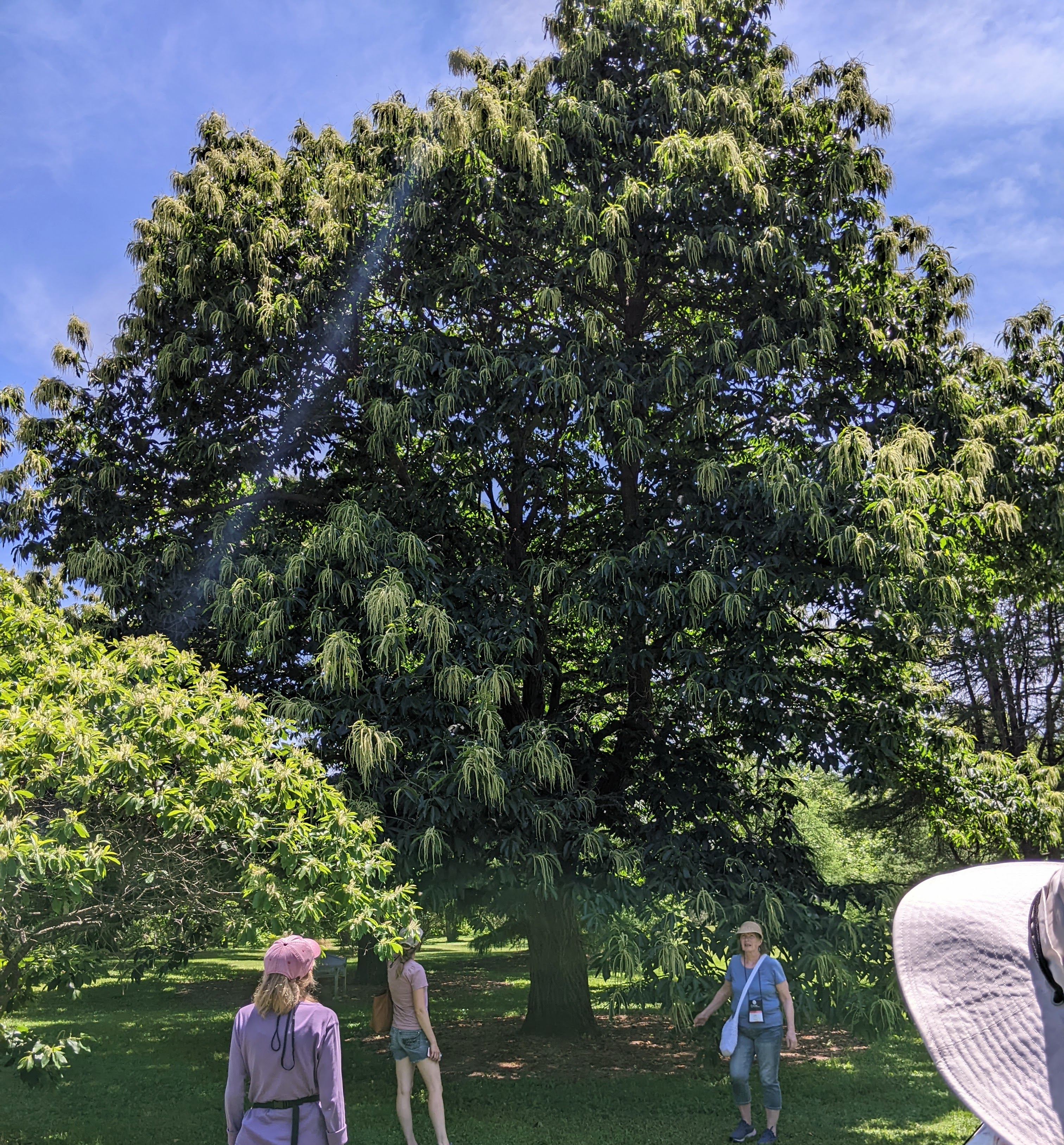
The Chestnut has both male and female flowers on one tree, monoecious. The long stalks are the male flowers. Their pollen is spread by wind and some pollinators.

Below is a photo of the Allegheny Chestnut, Castanea pumila, which was growing near the American Chestnuts. You can easily see the male and female flowers.

The American Chestnut seeds/nuts are edible- think Nat King Cole singing 'Chestnuts Roasting On An Open Fire'. Their hull is spiny. In the Arboretum many of the turkeys and deer enjoy eating these nuts. The leftover hulls are under the tree.

Wish we had more time in the Arboretum, there were so many great trees to see. Onward to more Fling posts...stay tuned.
©Copyright 2022 Janet. All rights reserved. Content created by Janet for The Queen of Seaford.
words and photos by Janet,The Queen of Seaford.