Monday, September 3, 2012

Tuesday's Trees- Aralia Spinosa

Aralia spinosa, also called Devil's Walking Stick, is a native to the Eastern United States.  Some may call this a shrub, but I decided since it is in the tree book I have listed as a tree, I will include it in my Tuesday's Trees.
 Walking through the woods this is not the tree you want to brush against, grab hold of, or use as your walking stick.  The thorns along the bark keep animals from rubbing against them.  Some trunks are covered more densely than others, but this is a key characteristic of the Devil's Walking Stick.  It has other names, one of which is Hercules' Club.  Can you imagine that as a weapon?


The Aralia spinosa can form a bit of a thicket or colony spreading by its roots.  If you were walking through the woods it would not be good to get into the middle of this colony.  
I have many of these trees in the lot next to me.  A couple winters ago we worked on getting some of the front area cleared out.  Many of the vines; smilax, muscadine grape, honeysuckle, and more honeysuckle were removed.  I also pulled some of the Aralia spinosa.  My rational was that there are plenty in the lots on either side of us.
A mature tree can be up to 20- 30 feet tall.   The more mature trees have shallow furrowed bark with the spines barely showing.  From the photos I would estimate a mature tree's diameter to be about 6- 8 inches.  Life span is about 25- 30 years.
The tree can tolerate some shade, but according to one government site where control of this tree is important, a dense canopy is one way to weaken the growth.  Fire is another method of control.  Cutting the stems will only invigorate new growth from the roots.    They can be found in upland woods, in moist soils where lands have been cleared.

The leaves are compound, bi-pinnate and sometimes tri-pinnate.  Some of the larger leaves have over 100 leaflets and can measure up to four feet in length.  This photo shows the wide branching of the leaves, all at the top of the stem.  Each year's growth comes from the top of the stem.  This one is about 6 feet tall and the stem is about an inch in diameter.  It is not mature enough to bloom.

The ones in the lower lot are quite mature.  As they are a thicket, I have not gone down into the base to see how tall they are.  The summer show of blooms was amazing.  This is a nectar plant for many butterflies and bees and other insects.  

There was a lot of insect activity on these blooms --  lovely aren't they?

These blooms become gorgeous berries in the fall.  These berries are food for birds.  The berries are just starting to form.  Some flowers are still visible.

Here is the beautiful berry, I love this color.   All those blooms are starting to ripen.

Here is a close-up of said berries.   The native Americans used many parts of this plant for medicinal treatments.  The roots were used as a poultice  for boils and swollen veins, internally as an emetic (to vomit), and as drops for sore eyes.  Young roots are poisonous.   There were all sorts of remedies for toothache, venereal disease, rheumatism, and other ailments.  The U Mich site has a list. 

The leaves in the fall are mainly yellow, though a couple websites said they can be red to orange to yellow.  I will get better photos in the fall and update this page.  Please come back.

References include Duke, UCONN, VA Tech, Wildflower ORG, Forestry Service, and  NC State.

©Copyright 2012 Janet. All rights reserved. Content created by Janet for The Queen of Seaford. words and photos by Janet,The Queen of Seaford.

Saturday, September 1, 2012

Why Here and Not There? Why There and Not Here?

Last night was a Blue Moon.  I am sure many of you were able to get fantastic photos of the moon as it rose in the sky.  We saw it on our way home from dinner, but because of our location, it wasn't until it was higher in the sky that we were able to see it from our property.    A grainy but interesting photo of said Blue Moon. I do like the jet trails in the sky.  


That photo was taken at the top of the driveway, some of the neighbors had a much better view of the rising moon.  Their views over the lake face east....ours is north.  I am glad I don't have the rising sun shining in my bedroom windows.  

At the top of our yard, by the street is pretty untamed.  I find interesting plant material up there.  The newest find is a Liatris, probably possibly  Liatris graminifolia  or perhaps something else.  My books say the Liatris in SC are difficult to distinguish.  I thought it might be a Carphephorus bellidifolius, but don't think so.   There are two plants at the edge of the woods.  I haven't seen this anywhere else in my woods, yard, garden, or along the street as I walk the dogs.  Hope it reseeds and there are more next summer!


Everywhere in the woods, I find this little Euphorbia.  This one was previously IDed for me by Daricia.  E. corollata or E. pubentissima.  Either way, it is cute scattered among the other wild things.  


Curiously, I have two Helianthus sp. in the woods outside my dining room window.   I see it blooming along the roadways all through the area, except in our neighborhood.  These two are the only ones I have seen.  Curious.  I love the bright yellow in the woods, the color just pops.  


When I take the dogs for a walk I keep my eyes open for something other than chinese lespedesa or blackberry brambles....the two most commonly growing things on vacant lots.  

Both last year and this year I have seen this plant in the photo below, in ONE location.  To me it looks like Mountain Mint, Pycnanthemum pycnanthemoides.   This is as close as I got to it,  about 6- 8 feet away.  Perhaps in the later fall, if there is still some vegetation left, I might venture in to see if I can find a squared stem or leaf arrangement.  Currently I am in my fifth consecutive day since May without a bug bite needing 'After Bite' or Cortisone Cream or Benedryl Cream.  I would like to make at least make it a week!!  I have had more bug bites this year, mostly chiggers, though some might be spider bites.  

Funny this is nowhere else in the wooden lots along our street.  Believe me, I am always on the lookout!!  


The Passiflora incarnata mentioned in past posts, growing near my tiny Sassafras tree is another mystery.  For those who know this vine, it has amazing underground rhizomes  that travel great distances.  There should be a lot of these vines in my location, if there is one, there must be a lot.  I have many other vines that fill the woods, surely there must be some other Passion vines.  Haven't seen any, zero, nada.  Maybe this one is the pioneer seedling, dropped by a bird, left to germinate and grow in my yard along the driveway.  Again, very interesting. 

  Finally, I leave you with a picture of the sunset last night.  If we go down to the water, out on the dock, we get beautiful evening skies.  I suppose it all comes down to location, location, location....and we sure love ours!!  Happy Labor Day weekend to all!


©Copyright 2012 Janet. All rights reserved. Content created by Janet for The Queen of Seaford. words and photos by Janet,The Queen of Seaford.

Tuesday, August 28, 2012

Tuesday's Trees- Persimmons

Persimmons, Diospyros virginiana, with that tart, puckery fruit is a native tree.  We used to have some in our backyard in Virginia. During this hurricane season I am reminded of these trees.  As we watched the winds and rain, we were worried about trees coming down.  I made a comment something along the lines that 'if we were going to lose any trees, I hope it is those' pointing to the Persimmons...as they fell.   Ha! They were pretty close to the edge of the yard, hanging over the bulkhead, and then they were in the creek.

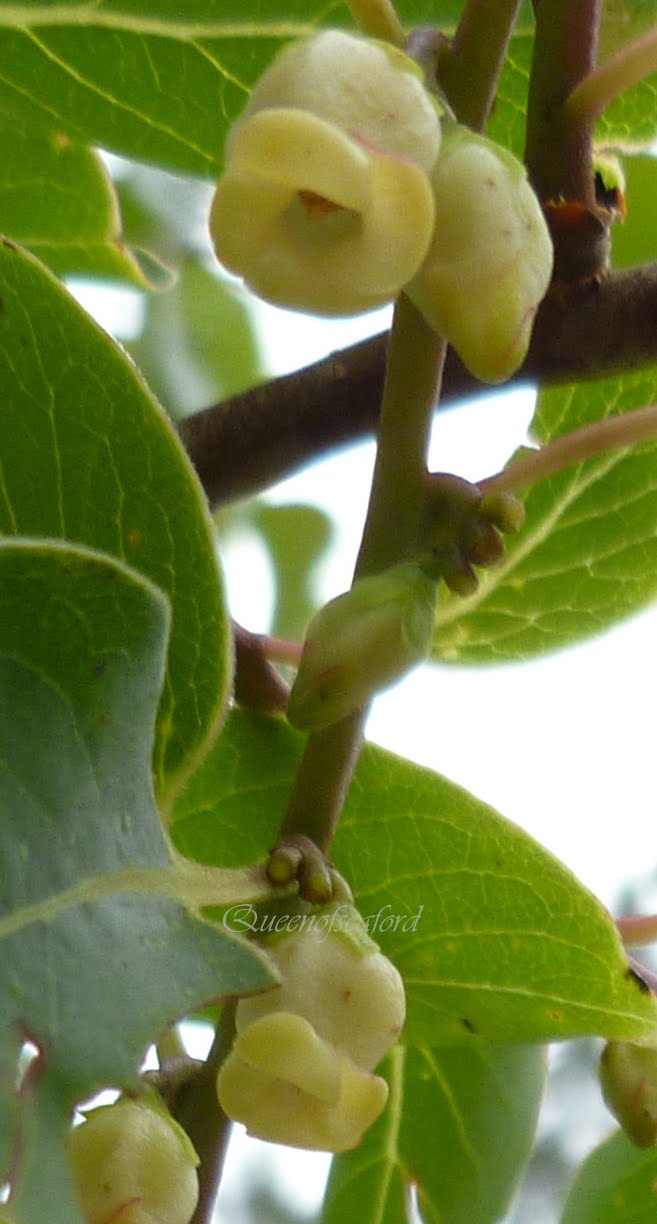
Fast forward to our new place in South Carolina.  Up by the street I found a young tree with these interesting flowers in the spring.   These waxy little bell shaped blooms are about a half of an inch, creamy white, and hang in either clusters of three (males) or singles (female).   This is a dioecious (two households) tree, each tree being either male flowering or female flowering.  One very rare occasions there are perfect flowers, meaning  both stamens (male) and pistils (female) are present.


From the looks of it, I have a male tree in my yard.  


Though I was confused by this picture below, singular blossoms.  Look closely at the left-hand side of the photo, see the double stem ends?  This is evidence that there WERE two or more blooms, but they fell off.  


You can see better from this angle, some of the blooms have fallen off.  


The leaves are glossy and arranged alternately along the branches.  The edges are smooth.   The native range covers almost the entire United States, minus the states along the Canadian border.  It can grow in full sun to part shade and prefers moist soil.  A mature tree will be 30 -50 feet tall and have a rounded oval crown spreading 20- 35 feet in width.  
According to Wikipedia, the name Diospyros roughly translated means divine fruit.  The common name persimmon is from the Algonquin language, meaning 'a dry fruit' -- written in English could be spelled putchamin or pessamin or pasiminan.   
It is a member of the ebony family.  The hard wood has been used in golf clubs.  I found it interesting that it has also been used in musical instruments.  The hard wood has been used as drumsticks.  Hard wood is often used as shuttles, billiard cues and hand carved  wooden bowls.  

The bark is one of the distinguishing features, dark and blocked bark.  It is very similar to the bark of a mature dogwood.  

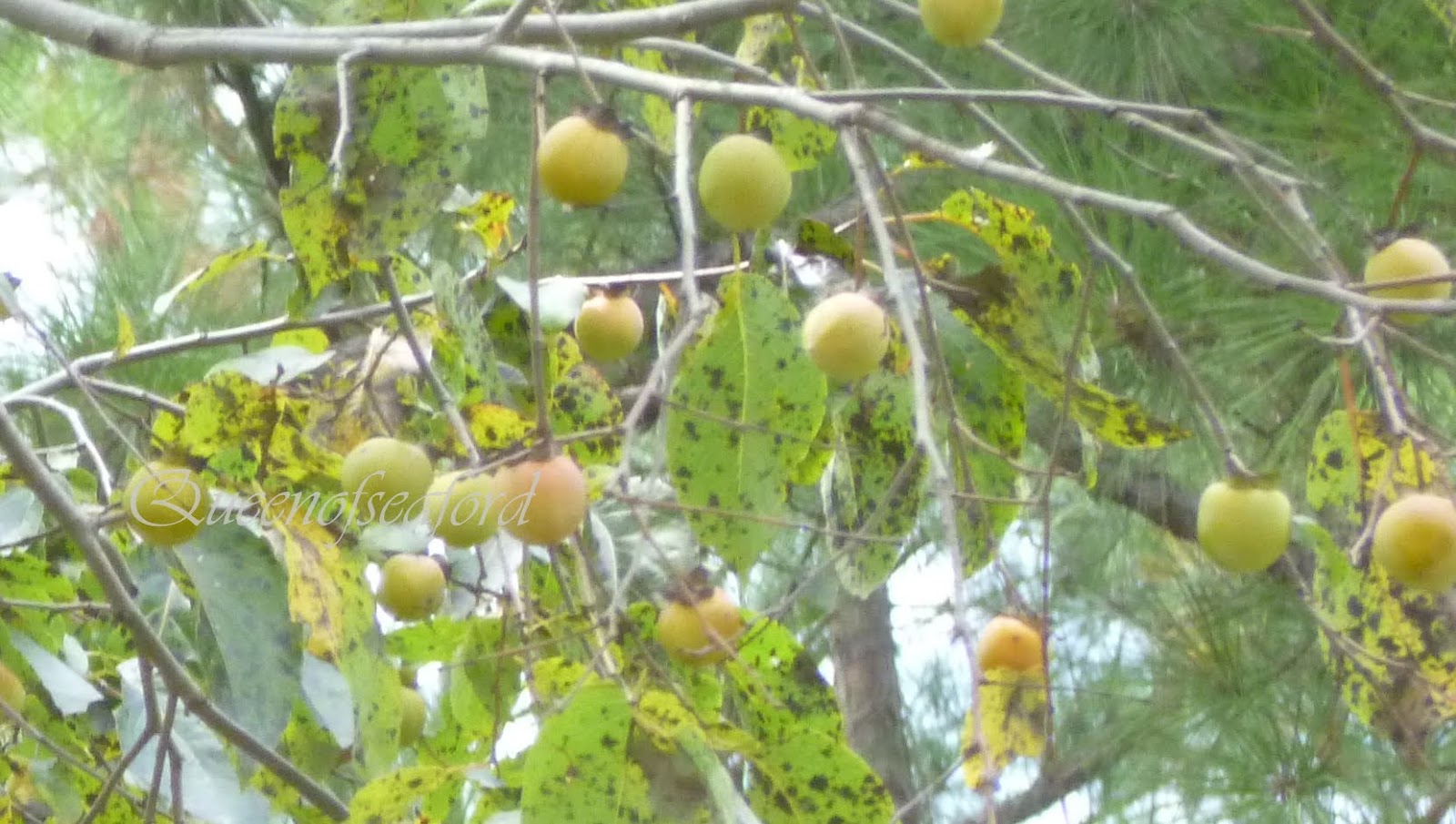
The fruit appears in late summer.  Besides the dark bark, seeing the fruit hanging on these trees makes it an easy identification.  The fruit turns a yellow-orange when ripe.  

 The tree has some pests.   There is a bark and phloem borer that can infest young nursery trees.   There are insects that defoliate, webworms and a hickory horned devil.  There is a persimmon wilt, Cephalosporium diospyri that can kill a tree.  This fungal disease will cause the leaves to wilt, defoliate, and the branches die from the top down.  Diseased trees should be removed and burned.


 The fruit is enjoyed by  many birds and mammals, to include deer, fox, skunks, turkey, and opposum.  The flowers are attractive to bees in the production of honey.  This is additionally a butterfly larval plant for the Luna moth.

Updated photo of the fruit.  Not the best photo, fruit is up high, but you can see the tops of the fruit, a large leafy crown.


ripe fruit -- not large
fall color 


©Copyright 2012 Janet. All rights reserved. Content created by Janet for The Queen of Seaford. words and photos by Janet,The Queen of Seaford.