Tuesday, March 29, 2011

We Interrupt Your Previously Scheduled Tree Posting


Yes, I realize many of you are looking for this week's tree posting.  Let's just say that a lovely day got the better of me.  We have had much needed rain for the last few days and today--THE SUN WAS SHINING!  I called one of my neighbors and we went over to Park Seed Company/Wayside Gardens.  This lovely Japanese Maple was just shimmering with its spring apricot colors. 
The Trial Gardens are getting prepped for the new year's trial plantings.  Surrounding the garden beds are some wonderful garden areas.  There is a Ornamental Grass and Its Companions garden, a Rose Garden, a Deer Resistant Garden, a Winter Interest Garden.....all sorts of great plants to enjoy. 

I  love the River Birch in the foreground and the Redbud down near the garden trial beds.  There are some mature trees through this garden and add much needed shade come June and the Festival of Flowers.  The Festival of Flowers is a month long celebration in Greenwood, SC that has many activities throughout the month.  Check out the link and see all the wonderful gardening events there are for this festival.   Today the gardens were quiet, relaxing and an enjoyable place to spend a little time.
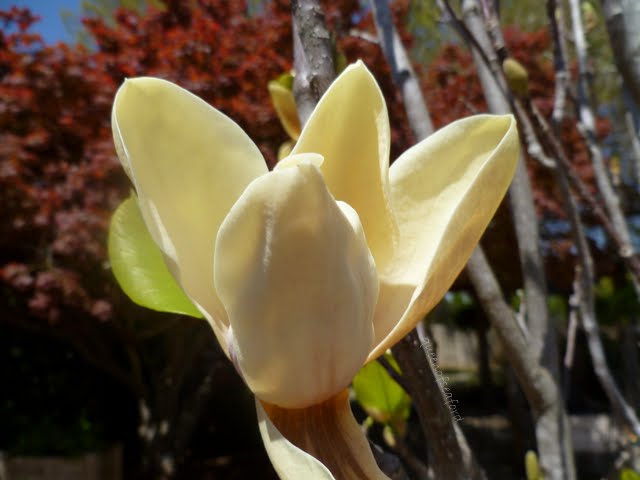


Doesn't this yellow Magnolia look lovely?  I asked inside about the name of this one, but since there was no longer a name tag, they were unsure.  I am hoping it is Magnolia 'Elizabeth'.  (more about that later)


There were a couple different varieties of Cercis in bloom.  What a color!! I love it.    The blue sky was the perfect backdrop to this magenta bloom.

So many trees and plants budding out, love the yellow foliage on this Dawn Redwood.  With a name like 'Gold Rush' one would believe it will stay yellow.


You would not believe how large this Bleeding Hearts plant was-- I would estimate it was about 24 inches tall and equally wide.  It was impressive.


In addition to the pink of the Bleeding Hearts there was a glorious display from a Flowering Cherry.  I couldn't find the tag for this one, so it will just be labeled 'Flowering Cherry'.


I love the foliage of this Hydrangea, believe it is H. quercifolia 'Little Honey' .....the yellow echoes the yellow in the center of these Primroses.  The photo doesn't do it justice.


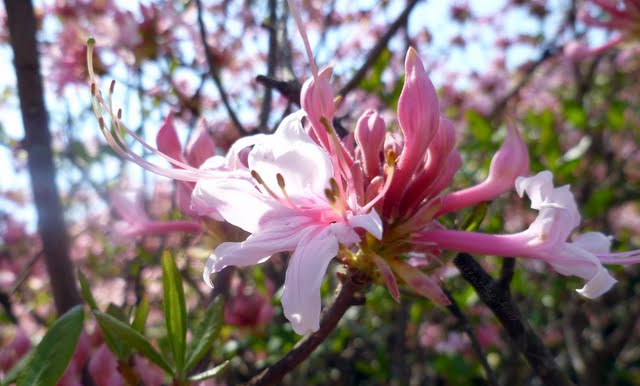
As we were leaving we checked out the large shade loving plants against the building.   A large (about 8- 10 feet tall) deciduious azalea was just getting ready to open... alas, no fragrance. 

Rest assured my fellow garden friends.....I did not come home empty handed!!  As Park Seed was having a special on Hemerocallis, I bought 10 of them and a few other things as well......

So the tally is-- 4 Hemerocallis 'Strawberry Candy', 3 H. 'Aztec Gold', 3 H. 'Sammy Russell', a Magnolia 'Elizabeth' (hoping it is like the one pictured above!!), a no-name green foliage Japanese maple, one Baptista 'Solar Flare/ Prairieblue', and one Achillea 'Red Shades'.  Most of the Daylilies were divided at least in two, the Achillea divided into four pieces, and yes.....everything is in the ground!!! 

©Copyright 2011 Janet. All rights reserved. Content created by Janet for The Queen of Seaford. words and photos by Janet,The Queen of Seaford.

Thursday, March 24, 2011

Some Spring Successes and Some, Not So Much

Spring has burst forth with an abundance of dogwoods opening all over our landscape.   The big things; trees and shrubs, are easily seen in the garden as they bud and leaf out.  In our garden we added 5 dogwoods, all in various stages of opening.  The native ones in the woods around us are further along. 

Under this Dogwood and in between the Hellebore I scattered some seeds.  Lona, A Hocking Hills Gardener, sent me some seeds last summer.  I had admired her Nicotianas and she sent me some of those and a couple varieties of Columbine.  Columbine should be scattered in the fall/winter.  This is the area between the Hellebore---

There are lots of leaves and pinecones and pinestraw on my garden floor.  This is the semi-shady garden.  I have oaks and hickory and some elm in my garden area.  This fall I let the leaves stay where they fell, adding to my mulch layer.  When the seeds were scattered I moved all the mulch off to the side and made sure of good seed to soil contact.  Well, now I wanted to find these little seedlings.  Like I said, some were under the Dogwood and some between the Hellebore. 


Success in both locations!!! Hallelujah!  Not sure if they will continue to thrive, they are so small and the dogs still run through the garden.  I try to plant tender things near a tree or shrub to protect it.  Keep your fingers crossed!


During the hottest and driest part of the summer/fall I thought these tiny Astillbes were getting enough water.  After looking more closely at the Dogwood they were planted in front of and seeing it showing signs of needing water, I wondered if these Astillbe would make it.  I planted ten little plugs of a pink variety.  Yesterday I counted 10 little plants!!  Woo hooo.

Out front I have some bulbs in the driest, worst soil --- near where we had planted 'Little Bluestem' grasses.  I have a sundial and thought some Muscari and Daffodils surrounding it would be nice.  Another success story!  The Daffodils are blooming yet, but they are all up. 


Three Rhus aromatica 'Lo Grow' are starting to leaf out.  Very nice.
 This is growing along the bank near the water.  It will be nice as it fills in.  Right now there are just three sprigs....but they are alive and growing!

Also on the bank are five Geranium 'Rozanne', and yes, all five are accounted for.  Hoping they are happy in this location as it will bring some nice color to the bank.

Yes, there are two Loropetalum left...out of 8.  The deer took them out of the ground, rootball and all.  The two that are left are blooming right now...this is a small success.

Now, my 'Not So Much' category-- I bought 24 plugs of Ajuga 'Burgundy Glow' and planted it in a few locations.  Of those 24 plants, I have found ONE returning.  Now there may be more still under the leaf litter, but so far I have not found any.

How did your garden fair over the winter?  Successes or Not So Much? 


©Copyright 2011 Janet. All rights reserved. Content created by Janet for The Queen of Seaford. words and photos by Janet,The Queen of Seaford.

Tuesday, March 22, 2011

Tuesday's Trees- Wax Myrtle, Myrica cerifera

Yes, yes I know, you say this is a shrub.  Well, ok, shrub or small tree, either way, this is the plant we are profiling this week. 
I planted five of these small, evergreen trees last fall.  We interplanted them with Osmanthus fragrans.  The row of these two evergreens was planted to establish a barrier along the side of our property.  As spring rolled into our midst I noticed that some of these Wax myrtles had some flower buds.  Let the investigation begin!

Wax myrtle is an evergreen tree that can reach heights of 40 feet, but more often is 15 feet tall.   The width is 6- 12 feet.  The glossy olive green leaves are alternating along the branches and aromatic when crushed.   


It can be left to its open and airy structure or sheared to form a hedge row or a tree.  It sends up suckering growth from the  root collar.  It also spreads laterally by underground runners to form colonies.  This tree has the capability of fixing nitrogen because of root nodules with a symbiotic actinomycete.  Because of this Wax myrtle thrives in infertile soils.   
The Myrica cerifera, now called Morella cerifera (don't you hate it when botanical names change???) has both male and female flowers on different plants, making it dioecious.  Flowers that are missing either the carpel or the stamen are called unisexual flowers.  I found mine were showing a good number of males flowers.  See the photo on the left.  Both the male and female flowers form in the leaf axils.
I searched and searched on the five plants for some evidence of some female flowers.  Duke's web site has some great photos of both the male and female catkins (flowers).  I believe this is a photo of very immature female flowers on my ONE tree.


I believe this because here is evidence of last year's drupes, also pehaps showing some beginnings of this years female flowers.   I first learned of Waxmyrtles when I was on a field trip to Colonial Williamsburg.  These tiny drupes have a waxy coating (hence the name cerifera--in Latin means wax-bearing)  The colonists took these drupes and boiled off the wax and used the wax for candles--Bayberry candles.  Some places still use this technique to harvest wax for candles.
The aromatic leaves can be used as a insect repellent, especially fleas according to the  Floridata website.  They go so far as to say a sprig of this in your closet or drawer will keep cockroaches away.  The fruits are high energy drupes for the birds, especially in the winter.  The Myrica cerifera is also the host plant for the larva of the Red-banded Hairstreak and the Banded Hairstreak butterflies. Photos of these can be seen at the LBJ Wildflower website.

This tree is hardy from zones 7- 10 and is a native to the Southeast regions of the United States.   Plant is in full sun and give it the room to form a nice sized plant.  It can handle wet or dry conditions and grows in heavy soils.  The Forestry Service website has plenty more information on growth, habitat, reproduction and other ecological data.


Additional information sites-- VATech and NCState, both good descriptions of this plant.


I hope more than one of my five trees are females, I would like lots of drupes for the birds and other wildlife. 


Stay tuned next week for more Tuesday's trees.


©Copyright 2011 Janet. All rights reserved. Content created by Janet for The Queen of Seaford. words and photos by Janet,The Queen of Seaford.